Storing a Motorcycle or Scooter Indoors Through a Deployment
Indoor motorcycle and scooter storage for deployment: fuel, battery, and tire prep plus a documented start-and-move routine in Chesapeake, VA.
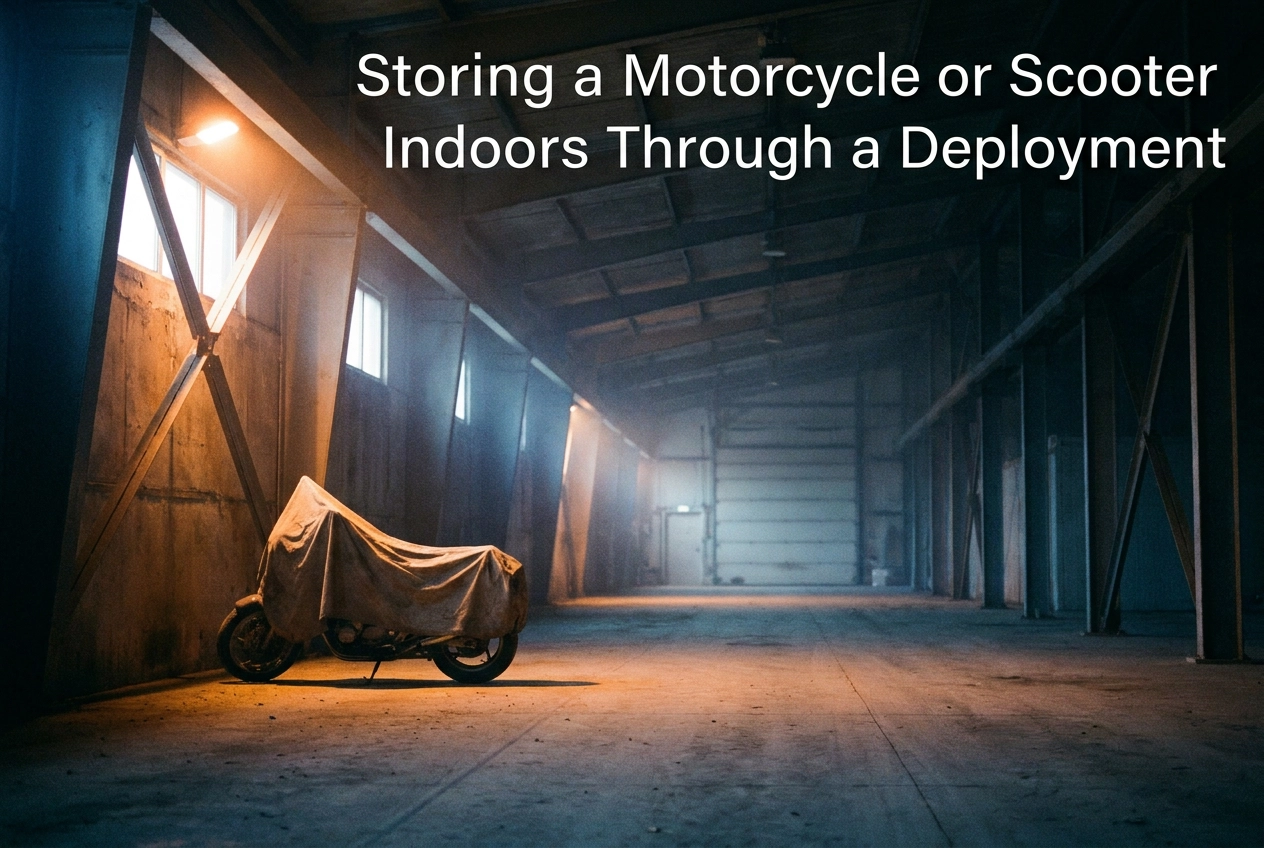
The relief of a homecoming after a long deployment is something every service member looks forward to. But for motorcycle and scooter owners, that anticipation often comes with a nagging question: will the bike still start? Two-wheelers have unique storage failure modes. Ethanol-blend fuel can gum up carburetors, batteries drain, and tires flat-spot under a simple cover on concrete. A motorcycle stored for a deployment can deteriorate faster than a car, turning a quick ride into a fuel system rebuild.
The solution is a gated, indoor vehicle storage unit and a documented start-and-move routine. This guide covers everything you need to know to protect your two-wheeler while you're away. We'll walk through why bikes deteriorate faster than cars, how the Chesapeake climate affects storage, and a complete deployment prep checklist covering fuel, battery, tires, and fluids. You'll also learn what to look for in indoor vehicle storage units, from security features to access, and how to hand off a start-and-move routine to someone you trust. Let's make sure your bike is ready to ride the moment you return.
Why Two-Wheelers Deteriorate Faster Than Cars in Storage
Six to twelve months is not a long weekend. A car mostly fails one way in storage. A motorcycle or scooter has three clocks running: fuel, battery, and tires. Manufacturer owner's manuals note that carburetor float bowls and injector bodies hold little fuel, so a large share sits exposed to air. Battery-maker guidance warns that self-discharge plus parasitic draw from clocks, ECUs, and alarms can push a small battery past recovery in a few months. Tire manufacturers' storage guidance describes flat-spotting when a bike's weight rests on small contact patches. Together, a carburetor rebuild, a replacement battery, and a pair of tires can cost as much as a year of indoor deployment parking.
Why a Cover in the Driveway Isn't Enough (Salt Air, Humidity, and the Chesapeake Climate)
A cover is a dust and UV barrier, not a climate. In a humid Chesapeake summer, a tarp or fitted cover can trap condensation against paint, chrome, and fasteners while wind-driven rain still reaches the underside and chain. Hampton Roads adds a coastal marine variable: airborne chloride accelerates corrosion on fasteners, fork tubes, brake hardware, and unpainted aluminum, a risk NASA monitors at its coastal exposure sites. Daily heating and cooling then pulls moisture in and out of the fuel tank and crankcase breathers, feeding seasonal fuel degradation. A covered bike also signals an empty house and a vehicle nobody is watching for a year. A gated garage with keycard access, 24/7 video surveillance, and regular patrols does not. Pair the cover with genuine indoor storage.
Deployment Prep Checklist: Before the Bike Goes Into Storage
Before the bike goes in, work through two windows. Fuel and fluids first, so the tank is stabilized and the crankcase holds fresh oil. Battery last, so it is not sitting discharged while you handle everything else.
Your primary source for every step is the owner's manual for your specific make and model. Manuals differ on stabilizer ratios, storage pressure, and whether periodic starting is recommended at all. Pull yours.
Document baseline condition with dated photos: odometer, tire tread and DOT date code, a battery voltage reading, chain condition, and any pre-existing scratches. This protects both you and the facility.
Check your command's policy and unit-specific requirements on personal property and long-term storage before finalizing plans.
Then draft the handoff sheet: one page the friend or family member will actually follow. The start-and-move section expands it.
Fuel: Stabilizing Ethanol-Blend Gasoline
E10 and similar blends are hygroscopic: they attract and hold water. Once saturated, the fuel phase-separates, and the water-ethanol layer dropping to the tank bottom can corrode fuel-system metals (EPA). Confirm the procedure in your owner's manual.
Typical manufacturer guidance:
Top off the tank to limit air and moisture exposure.
Add stabilizer at the ratio printed on the product label.
Run the engine until treated fuel reaches the carburetor bowls or injectors.
Carbureted bikes and scooters need the float bowl addressed separately. Many manuals say drain it; a bowl left full for a year lets varnish and water sit against the jets. Fuel-injected machines can instead keep a full stabilized tank plus the start-and-move interval.
Stabilizer slows degradation; it does not make gasoline shelf-stable indefinitely. Follow the manufacturer's stated window and do not extend it.
Battery: Remove, Disconnect, or Tender
With fuel stabilized, turn to the battery. Manuals frame three choices: remove it and store it indoors on a maintainer; leave it installed with a maintainer connected; or disconnect the negative terminal to stop parasitic draw. A trickle charger charges continuously, while a smart maintainer or tender drops into float mode and is safer for months unattended. Record voltage before storage, then have your caretaker log it at every check so decline appears as a trend. A battery does not drain through bare concrete; self-discharge and temperature are the drivers. If it stays in the bike, confirm ventilation, route the cord where it cannot be pinched, and verify the facility allows connected maintainers and provides power.
Tires: Pressure, Flat-Spotting, and Off-Ground Options
Tires bear full weight on two small contact patches. Manufacturers note prolonged static deflection can cause temporary or permanent flat spots. Inflate to owner's-manual storage pressure, often above riding pressure, and check at every caretaker visit. At each visit, roll a few inches to shift the contact patch. If possible, lift on front and rear paddock stands or the center stand to remove ground contact. Otherwise, place an insulating barrier beneath the tires. Concrete is not the problem; unconditioned concrete holds ground moisture and swings with outdoor temperatures, strengthening the case for climate-protected indoor vehicle storage. Tires age even with tread. Locate the DOT date code before storage; one that sits a year may need replacement on age alone. If storage includes a cruise, our guide to Carnival parking in Norfolk shows how indoor storage compares.
Fluids, Chain, Covers, and Paperwork
Tires are settled; the remaining items are service and documentation. Change the oil and filter before storage, per manufacturer guidance, because used oil is more corrosive than fresh and holds combustion acids and moisture. Check coolant level and freeze protection if the garage is unconditioned, and service brake fluid before storage since it absorbs moisture over time. Clean and lubricate the chain; a dry chain rusts at the rollers through a humid coastal winter. Follow the manual for belt or shaft care. Use a breathable cover, never a plastic tarp, and apply light protectant to exposed metal, fork tubes, and unpainted fasteners. Keep registration, insurance, and the storage agreement current, and leave the handoff sheet, a spare key if the facility permits, and contact details with your caretaker.
What to Look For in Indoor Storage for a Motorcycle or Scooter
With the bike prepped and documented, the facility becomes the variable you cannot control later. Judge any indoor vehicle storage units against five criteria, not a brand name.
True indoor means a fully enclosed, gated, multi-level garage, not a canopy, carport, or outdoor container marketed as climate controlled. Demand documented access control: keycard entry, 24/7 video coverage, and regular patrols, since months of absence is when theft risk peaks. Ask motorcycle-specific questions before signing: height clearance, how the bike is positioned, whether it stays on its own stand, and any two-wheeler fees. Get contract terms in writing: month-to-month versus long-term, deployment extensions, early returns, and whether a designated family member can access the bike. Compare that written standard against Indoor Monthly Car Storage Solution options.
Clearance, Access, and Positioning
Before you sign, verify clearance in person, not just by phone. A windshield, mirrors, top box, or a rider moving the bike adds height, so measure your setup against Asphalt Lots' listed 7-foot-10-inch garage clearance and confirm that figure against current specifications at the Chesapeake facility's address page.
Ask how your bike will sit: center stand, side stand, paddock stands, or a marked motorcycle area. That answer determines footprint, aisle access, and tire load. Confirm access logistics too: whether you ride in or staff move the bike, how check-in and short-notice retrieval work, and whether an open-ended or extendable term is available without moving the bike. Request a walk-through; the ramp, turning radius, and actual surface beat any phone description of indoor vehicle storage near me.
Security: Gated Entry, Surveillance, Patrols
Once access logistics are settled, evaluate the security stack. A gate stops casual entry; keycard access logs who entered; 24/7 video covers the space; patrols close the gaps between camera views. This matters more for a two-wheeler. A bike is easy to roll away, and a covered bike in a driveway signals an absent owner as clearly as a stored one.
Asphalt Lots operates a gated, multi-level garage with 24/7 video surveillance, keycard access, and regular patrols, matching those criteria. Ask whether cameras cover motorcycle areas, not just entrances, and how long footage is retained; a months-long absence needs a long lookback. Check your policy wording too, because many policies require locked, secured storage for long-term coverage to apply.
Who Checks the Bike While You're Gone
Security answers who can enter. It does not answer who touches the bike. A storage unit is passive, and twelve untouched months is exactly what the start-and-move routine prevents. Choose one of three models: the facility performs scheduled checks and moves, you designate a local family member or friend, or nothing happens. The third produces the rebuild story. Get any facility-performed check in writing: what is inspected, how often, whether the engine runs or the bike is only rolled, and who sends status updates. Asphalt Lots lists deployment parking for military personnel alongside monthly and long-term storage, so ask directly how it handles checks through a deployment. Regardless of policy, name a local contact with a key, the handoff sheet, and authority to approve service.
The Documented Start-and-Move Routine (And How to Hand It Off)
A written, dated checklist beats memory: the executor may be a non-rider who won't know normal. At each interval:
Walk and inspect. Check tire pressures vs recorded storage pressure. Look for leaks, new corrosion, pest damage. Note changes since last visit.
Start only if the manual permits. Run to full operating temperature in a ventilated area, not a 30-second idle that adds condensation without burning it off. Follow the manual's interval.
Roll the bike a few inches forward/back to change the tire contact patch, return it to its stand, and re-cover it.
Log the date, voltage, tire pressures, and observations in a shared document or group chat so the owner can track trends from overseas.
Write the sheet for a non-rider: key location, how the cover goes back on, facility contact, and what counts as "call me immediately."
FAQ: Indoor Vehicle Storage Units Near Norfolk and Hampton Roads
What does indoor storage cost? Asphalt Lots starts at $10 per day with complimentary round-trip shuttle; rates vary by term length and vehicle type. See storage services and FAQ.
Can I store my bike for a deployment? Yes. Deployment parking for military personnel is listed alongside monthly and long-term storage. Confirm motorcycle handling details and fees when you call.
Will it fit? The gated garage has 7-foot-10-inch clearance. Measure your bike with windshield, mirrors, and mounted luggage included.
Do I need a battery tender? Ask about power access and policy first. If a connected maintainer is not allowed, remove the battery and store it indoors.
How do I find storage near me? Use local signals: 1377 Bells Mill Road in Chesapeake, 15 minutes from the Norfolk Cruise Terminal, serving Hampton Roads and the Port of Norfolk. Reserve at 888-441-7275.
Reserve Indoor Motorcycle Storage Before Your Next Deployment
Fuel, battery, and tires each fail on their own timeline. One written routine covers all three: stabilized fuel, a maintained battery, and a dated start-and-move schedule. The choice is plain. A cover on concrete costs nothing and buys a rebuild. Gated indoor storage with a documented check policy buys a bike you can ride away.
Next: pull the owner's manual, complete pre-storage service, photograph baseline condition, and verify clearance, access control, and check policy in writing. Asphalt Lots is the local choice for deploying riders: veteran- and family-owned, founded July 2023 by retired U.S. Navy veterans Martin Parker and Bradley Metcalf, at 1377 Bells Mill Road in Chesapeake, with monthly and long-term storage plus deployment parking. Call 888-441-7275 or visit asphaltlotsva.com and book before the bike sits another week. We've got this. Go do what you need to do.
Conclusion
Indoor storage protects a motorcycle or scooter from the salt air, humidity, and temperature swings of the Chesapeake climate, and it protects your investment from the slow damage that a driveway cover cannot stop. Stabilize the fuel, pull or tender the battery, and address tire pressure before the bike sits. Then choose a gated facility with documented checks, secure access, and enough clearance for your mirrors and luggage. One written start-and-move routine, handed off clearly, keeps every system healthy while you are away.
The value is simple: you come home to a bike that starts, rides, and needs no rebuild. If you are deploying from Hampton Roads, reserve indoor motorcycle storage at Asphalt Lots, 1377 Bells Mill Road in Chesapeake. Call 888-441-7275 or visit asphaltlotsva.com today. Your next ride starts with the decision you make this week.