PCS Orders vs. Deployment: Vehicle Storage in Hampton Roads
PCS orders and deployment look the same on a calendar but need different vehicle storage answers. See what each scenario actually requires.
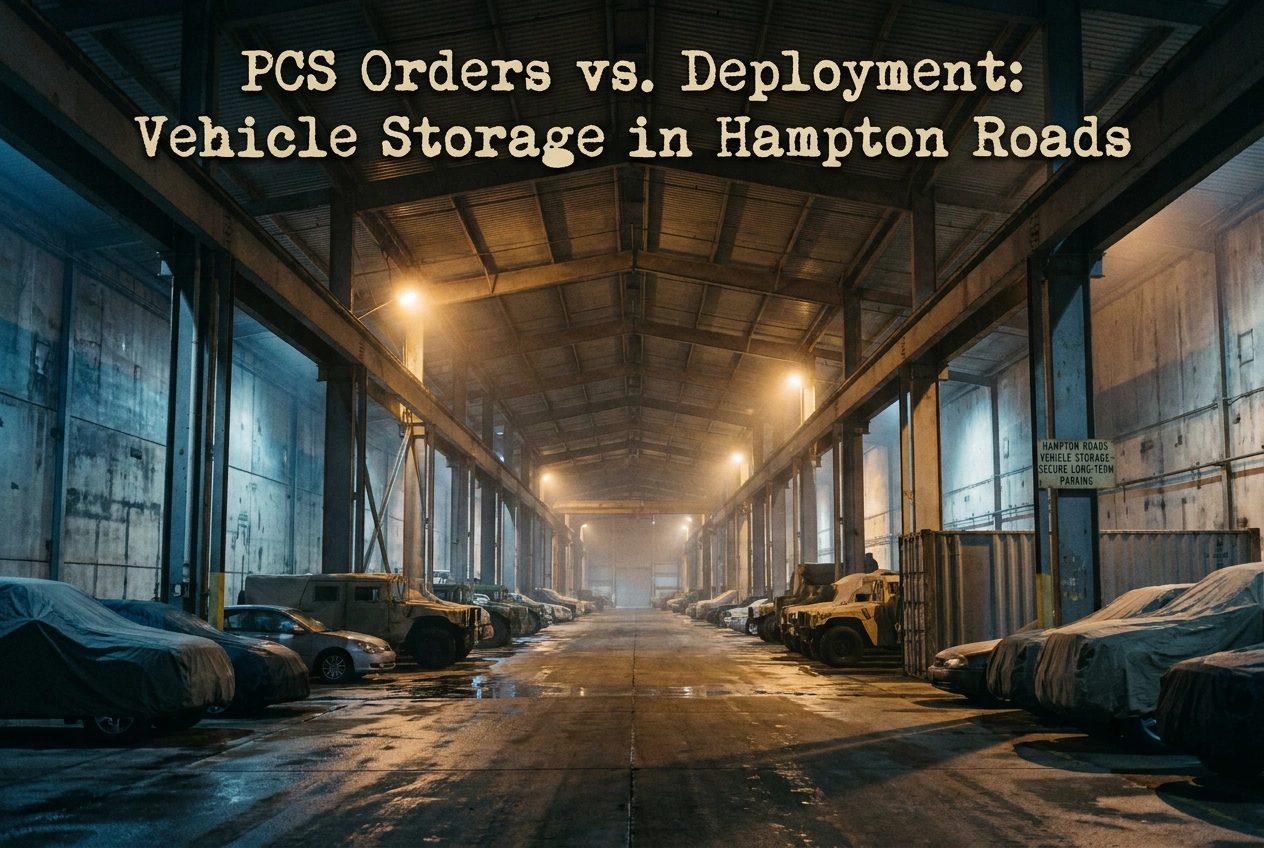
A PCS move and a deployment look identical on a calendar: the service member leaves, the car stays behind, and the household waits for a return date. In practice, these are completely different problems that demand different answers. PCS is a planned move with a known timeline and a clear shipping decision. Deployment is an open-ended absence, and the questions shift from logistics to survival. How does a car endure months of sitting still in coastal Virginia's humidity and salt air?
That distinction matters most when you evaluate vehicle storage indoor options in Hampton Roads. This post walks through the full comparison. It begins with why PCS and deployment only appear alike, then examines the shipping-versus-storing decision for PCS orders and what the Joint Travel Regulations actually cover, including where storage fits in CONUS and OCONUS moves. From there, it addresses the open-ended deployment problem, coastal Virginia's toll on a parked car, and what months of sitting does to batteries, seals, tires, and fluids. A side-by-side requirements table and guidance on selecting a provider round out the analysis. By the end, you will know which storage answer matches the orders you have.
The Calendar Illusion: Why PCS and Deployment Only Look Alike
On a calendar, a PCS and a deployment look identical: a departure date, a vehicle left behind, a set of keys handed to someone else, and a return date you cannot fully control. The overlap ends there.
PCS is a planned move. You have orders, a report-no-later date, and a destination, so the decision is whether to ship the privately owned vehicle or store it until you land at the gaining command. Deployment is an open-ended absence. The decision is how a car survives months of sitting still in coastal Virginia with nobody driving it.
The overlap is real but shallow. Both raise security, access, and cost questions, and both are answered badly by parking the car somewhere and hoping.
That is where the two problems separate. Climate control and regular start-and-move service are convenient during a PCS window. During a deployment, deployment parking demands them. That judgment comes from operational experience with stored vehicles in Hampton Roads, not from a single published study.
If you are searching for vehicle storage indoor, vehicle indoor storage, or climate controlled vehicle storage, you are almost certainly standing inside one of these two situations already. The next step is knowing which one.
PCS Orders: The Shipping or Storing Decision
Start with the funded, scheduled case. PCS orders arrive with a report-no-later date, a gaining command, and transportation entitlements defined in the Joint Travel Regulations. That schedule changes the question. Before asking where to store the car, ask whether the government will ship it.
For most CONUS-to-CONUS moves, you drive the vehicle yourself. OCONUS moves route it through a designated vehicle processing center.
If you ship, storage is a bridge, not a plan: days or weeks between drop-off and pickup at the other end. If you store, storage is a holding pattern tied to your report date. The window is known before you sign anything, so total cost is predictable and easy to budget against.
Because that end date is fixed, PCS storage can be booked after orders are cut and quoted as a fixed block rather than month to month. The same logic applies when a known departure date makes indoor space worth reserving early, as with Where Should You Park for a Carnival Cruise in Norfolk?.
What the Joint Travel Regulations Actually Cover
Before you commit to a storage contract, read the Joint Travel Regulations directly. The JTR is the authoritative source for official travel and transportation allowances, and its chapter index lists Privately Owned Vehicles (POV), Car Ferry Transportation, and Ground Transportation as separate sections (JTR, Appendix B). Reimbursement turns on the exact language about authorized travel days, mileage, and shipping entitlements, not on the summary a friend gave you at the barracks.
One recent change, MAP 52-26(I) dated October 1, 2026, clarifies that actual transportation costs may be reimbursed for a self-propelled mobile home driven over water. That change has nothing to do with vehicle storage and should not be stretched to cover it.
The key distinction: the JTR explains what the government pays to move a vehicle, not what it costs to keep one. Storage is generally a member's own decision and expense unless a specific entitlement applies to your situation.
Entitlements change. Verify current language through the Defense Travel Management Office and your installation transportation office before you build a budget around a reimbursement.
CONUS vs. OCONUS: Where Storage Fits In
CONUS moves usually take the vehicle with you, which makes any storage a short bridge between housing, a port, or a dealer, measured in days rather than seasons. OCONUS moves route the car through a vehicle processing center. Some services have issued branch supplements to the JTR that affect VPC selection; confirm current supplement language with your installation transportation office before relying on it.
Long OCONUS tours are the one PCS case that genuinely resembles deployment storage. The vehicle sits for a year or more with nobody driving it and no way to move it on short notice. Read relocation guidance directly rather than from a summary; Military OneSource and the Navy Fleet and Family Support Program are recommended starting points for PCS vehicle guidance, open their current pages and verify the content before you act on any summary. Your gaining command's transportation office settles a specific entitlement question fastest, so email before committing to a storage contract.
Deployment: The Open-Ended Absence Problem
If a long OCONUS tour hints at the deployment problem, deployment removes the calendar entirely. There is no report-no-later date, only an approximate window and a homecoming that can shift after you drop the keys off. That uncertainty changes the economics: you cannot price storage on a fixed number of weeks, and you cannot count on someone being available to move the car when the schedule changes again.
A car parked for one month and a car parked for ten are different vehicles at pickup. The gap is environmental and mechanical, not cosmetic. Coastal humidity, salt air, temperature swings, and months without airflow around the vehicle or through its brake and exhaust components keep working whether or not anyone is watching. That is the operational judgment this article rests on.
Why Coastal Virginia Is Hard on a Parked Car
The length of the absence matters less than what the car is sitting in. Hampton Roads sits on the Chesapeake Bay and the Atlantic, which makes salt and humidity the ambient environment rather than a weather event you can wait out.
Salt-laden air accelerates corrosion on exposed metal, brake rotors, fasteners, and undercarriage hardware, especially where paint or undercoating has already been chipped. Seasonal humidity swings drive condensation into metal components throughout the vehicle. That is how rust starts on a car that never turned a wheel.
A carport or a covered but unsealed space still cycles with outdoor humidity. An indoor storage facility with climate control significantly reduces exposure to the wet-dry cycle associated with the most corrosion damage. Distance from the water also matters. A facility a few miles inland can be a different climate story than a lot beside the terminal, which is a fair question to ask when comparing buildings.
That environment is only half the problem. The vehicle itself degrades on its own schedule.
Battery, Seals, Tires, and Fluids: What Months of Sitting Does
A battery self-discharges while parked and can be damaged beyond recovery if left at a low state of charge for weeks; a tender or regular start-and-move service keeps it serviceable. Tires can deform when one contact patch bears the vehicle's weight for an extended period; rolling the vehicle periodically redistributes the load. Seals, gaskets, and belts can deteriorate without regular use, and fluids may degrade over extended idle periods, consult your owner's manual for storage guidance specific to your vehicle. Brake rotors and calipers develop surface rust during extended storage; the Lexus pre-delivery bulletin calls for surface rust removal every eight weeks, which is why a stored vehicle may feel different on the first drive back. Regular start-and-move (typically every six to eight weeks per manufacturer guidance) means bringing the vehicle to operating temperature, rolling it, exercising the brakes, and confirming it still moves under its own power while you are gone.
Side by Side: PCS vs. Deployment Storage Requirements
Those mechanical realities explain why the two scenarios diverge. PCS has a known report date and a defined storage window. Deployment has an approximate window and a homecoming that can move earlier or later.
Duration risk follows. PCS storage typically runs weeks to a few months. Deployment storage can run well beyond the 90-day SIT baseline, often with no fixed end date. The coastal Virginia environment makes both climate controlled vehicle storage and regular start-and-move non-negotiable for deployment. Both scenarios need gated indoor space with monitored access. Deployment adds harder requirements: a provider who can handle an unpredictable pickup date, an authorized second driver, and a long-term rate that does not punish a shifted return. That distinction should drive your shortlist.
What Both Scenarios Still Need From a Storage Provider
The differences between PCS and deployment storage come down to timeline and duration, not to the quality of the facility itself. Certain requirements apply no matter which set of orders you are holding.
Get guaranteed indoor space in writing, not a covered spot that may be full the day your orders call for it. The building should be gated with controlled entry and camera coverage, so access is limited and every entry is documented while you are away. Confirm someone will be on site to accept the vehicle from a spouse, a friend, or a moving crew when you cannot be there in person.
Read the terms against the military reality: the daily or monthly rate, height and size limits, early and late return, who is authorized to retrieve the vehicle, and what happens if orders change again. Our frequently asked questions page is a reasonable place to start, but confirm the details of your own agreement.
For reference, Asphalt Lots states it offers guaranteed indoor vehicle storage in a gated, multi-level garage with 24/7 video surveillance and keycard access. Those are company claims, so verify current pricing, height clearance, and other specifics at reservation.
Choosing Indoor Vehicle Storage in Hampton Roads
You have the baseline requirements. Now match them to your specific orders. Ask the deciding question first: is this a PCS bridge or a deployment? If the car will sit beyond the standard 90-day SIT window, or with no defined end date, shop for climate controlled vehicle storage rather than just a roof.
Tour the building and inspect moisture handling directly: drainage, ventilation, dehumidification, and whether the floor stays dry through a rainy week. Ask how the provider handles a vehicle that will not start on pickup day, and whether jump service, battery tending, or regular start-and-move is included in the rate or billed separately.
Compare total cost over your realistic worst-case duration, not the daily rate; monthly and long-term rates usually beat paying the daily figure for a year.
One local option to evaluate is Asphalt Lots, a veteran- and family-owned facility in Chesapeake about 15 minutes from the Norfolk Cruise Terminal, founded in July 2023 by two retired Navy veterans. Its listed services include monthly and long-term vehicle storage and deployment parking, and its claims are worth verifying directly before you book.
Conclusion: Match the Storage Answer to the Orders You Have
Match the storage answer to the orders you actually have. A PCS move is a shipping and timing decision. A deployment is a duration and environment decision, and coastal Virginia makes the second one harder.
If your car will sit through a Hampton Roads summer or winter with nobody driving it, budget for climate control and regular start-and-move service from day one. Adding them after the first sign of trouble costs more than planning for them upfront.
Read the Joint Travel Regulations directly for what the government will and will not cover. Do not assume a shipping entitlement also covers storage.
Before you leave, confirm the essentials covered above: advance reservation, written limits, and a named authorized retriever.
Reserve a spot at asphaltlotsva.com or call 888-441-7275.